
What Kalshi's AGI Market Actually Measures
Kalshi's AGI prediction market does not simply ask whether AGI exists. It resolves on a qualifying company announcement under specific contract rules. Here is how to read the market correctly.
Prediction markets are easy to misunderstand when the headline is broader than the contract.
Kalshi currently runs a market asking when any company will achieve artificial general intelligence. The surface-level interpretation is obvious: traders are placing a probability on when AGI arrives.
The contract is narrower than that.
For the relevant market to resolve Yes, a company has to make a qualifying official announcement under Kalshi's written rules. The wording, timing, identity of the company, and verification source all matter. Kalshi makes this explicit in its market framework: the rules define the outcome, and the exchange resolves the contract according to those rules rather than a broader interpretation of the event.
That distinction became especially important after Nvidia CEO Jensen Huang publicly said that AGI had arrived following OpenAI's release of GPT-6 Astra. The statement created headlines and moved attention toward AGI markets, but a high-profile declaration is not automatically the same thing as a qualifying company announcement under a specific prediction-market contract.
The price is attached to a specific contract
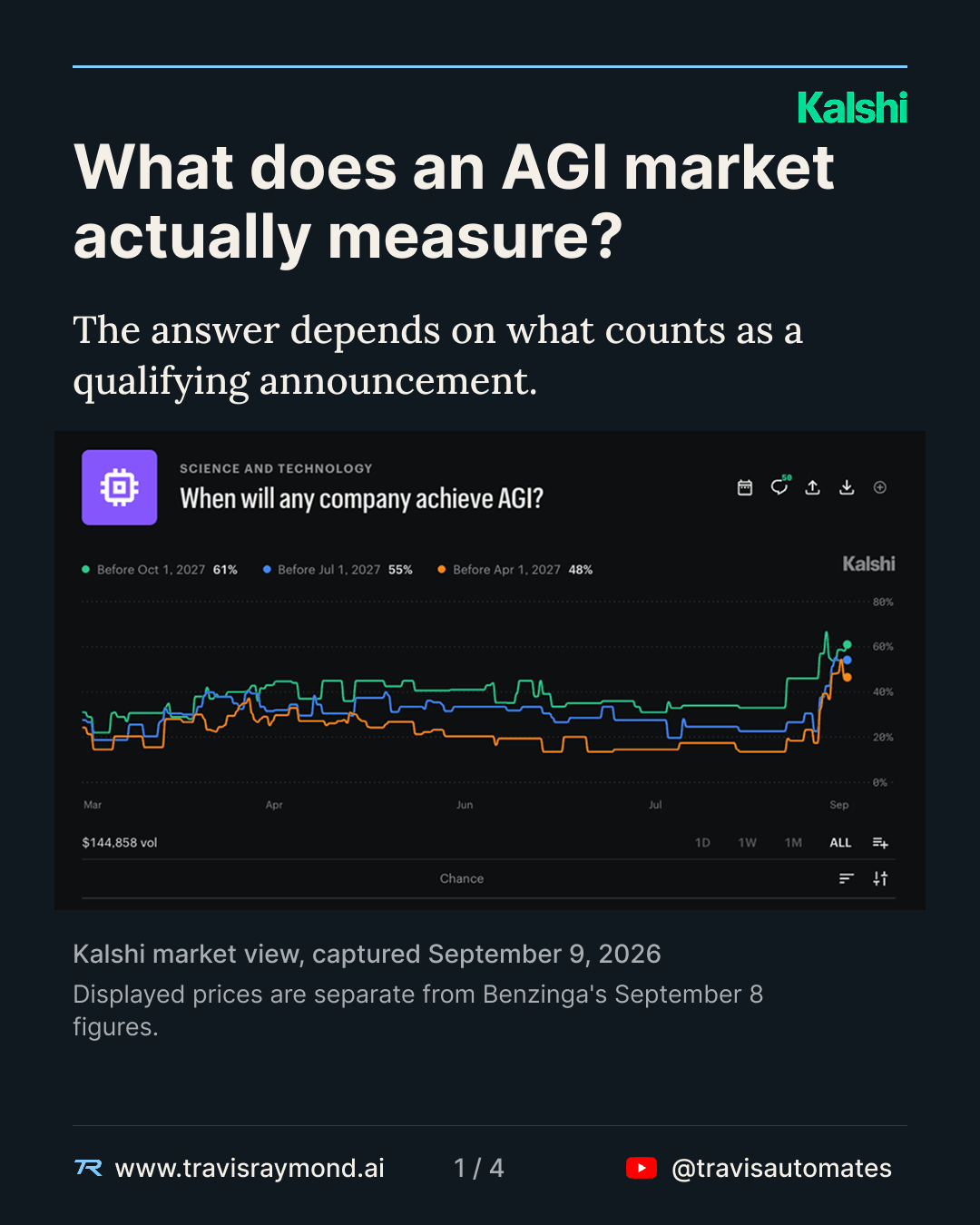
The first thing to understand is that the number on the screen belongs to a defined event.
On September 9, the captured Kalshi market showed several deadlines for the same underlying question. The displayed prices were 48% before April 1, 2027, 55% before July 1, and 61% before October 1.
Those numbers were not universal estimates of the probability that AGI exists by those dates.
They were prices on contracts with a specific resolution condition.
That is an important difference because a prediction-market price only has meaning relative to the exact wording of the contract. If the contract is asking whether a company officially announces it has achieved AGI, then the market is pricing that event.
It is not necessarily pricing whether an independent panel of scientists would agree that AGI has been achieved.
The screenshot should also remain clearly dated. Kalshi prices move continuously. The live page may differ from the September 9 capture.
The headline got ahead of the question
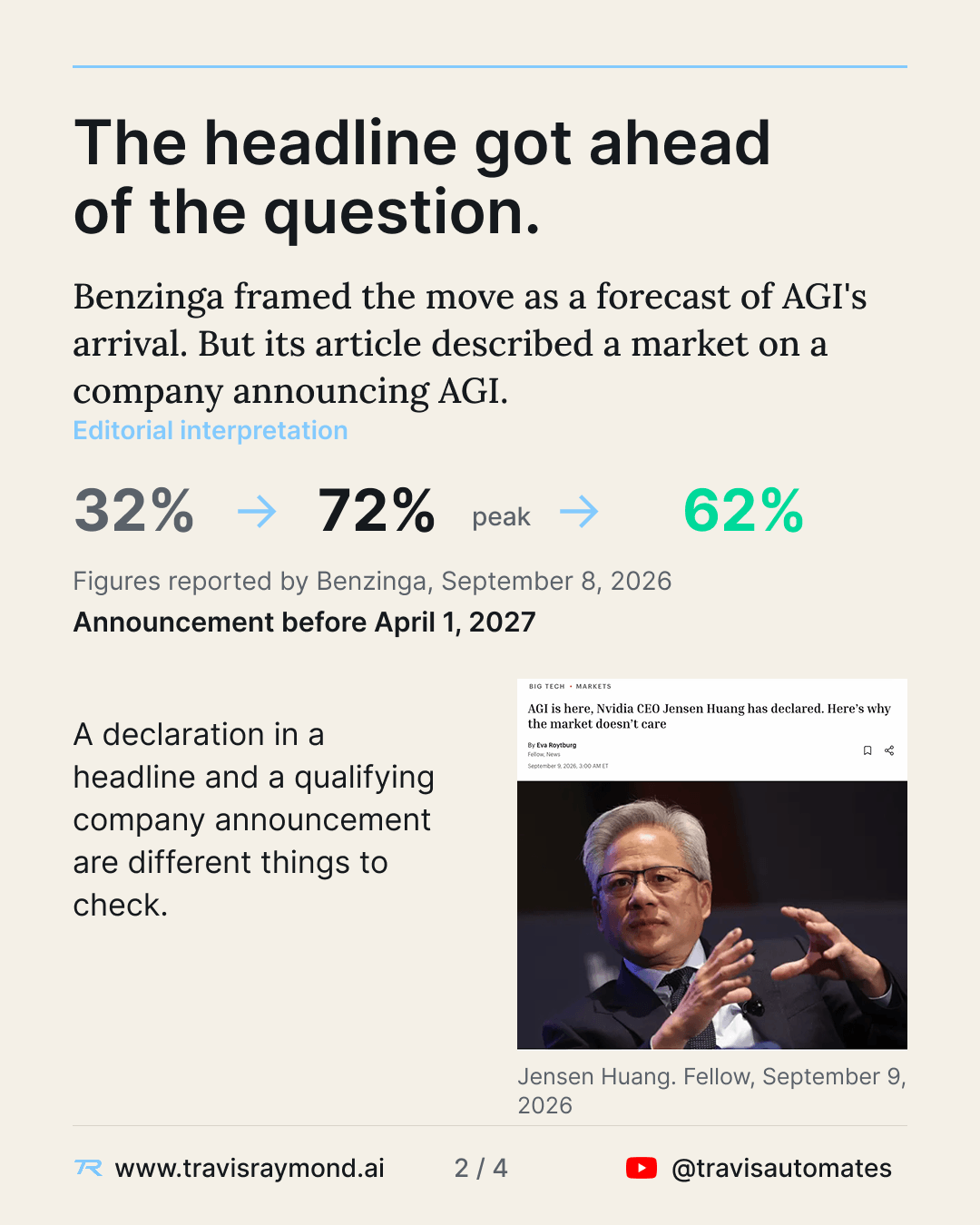
A headline can describe one event while the contract is measuring another.
Jensen Huang wrote that "AGI has arrived" while discussing OpenAI's GPT-6 Astra. That was a public statement from Nvidia's CEO about another company's model.
But the Kalshi contract is not asking whether Jensen Huang believes AGI exists.
It is asking whether a qualifying company officially announces that it has achieved AGI.
That makes the identity of the speaker and the subject of the statement important.
A CEO saying another company has reached AGI is different from that company issuing its own qualifying announcement.
Likewise, language such as "AGI era," "AGI-level," or "toward AGI" may sound close enough for a headline, but contract language can draw a much sharper line.
This is why the headline and the market price can appear to disagree without the market necessarily being irrational.
They may simply be referring to different events.
What actually qualifies
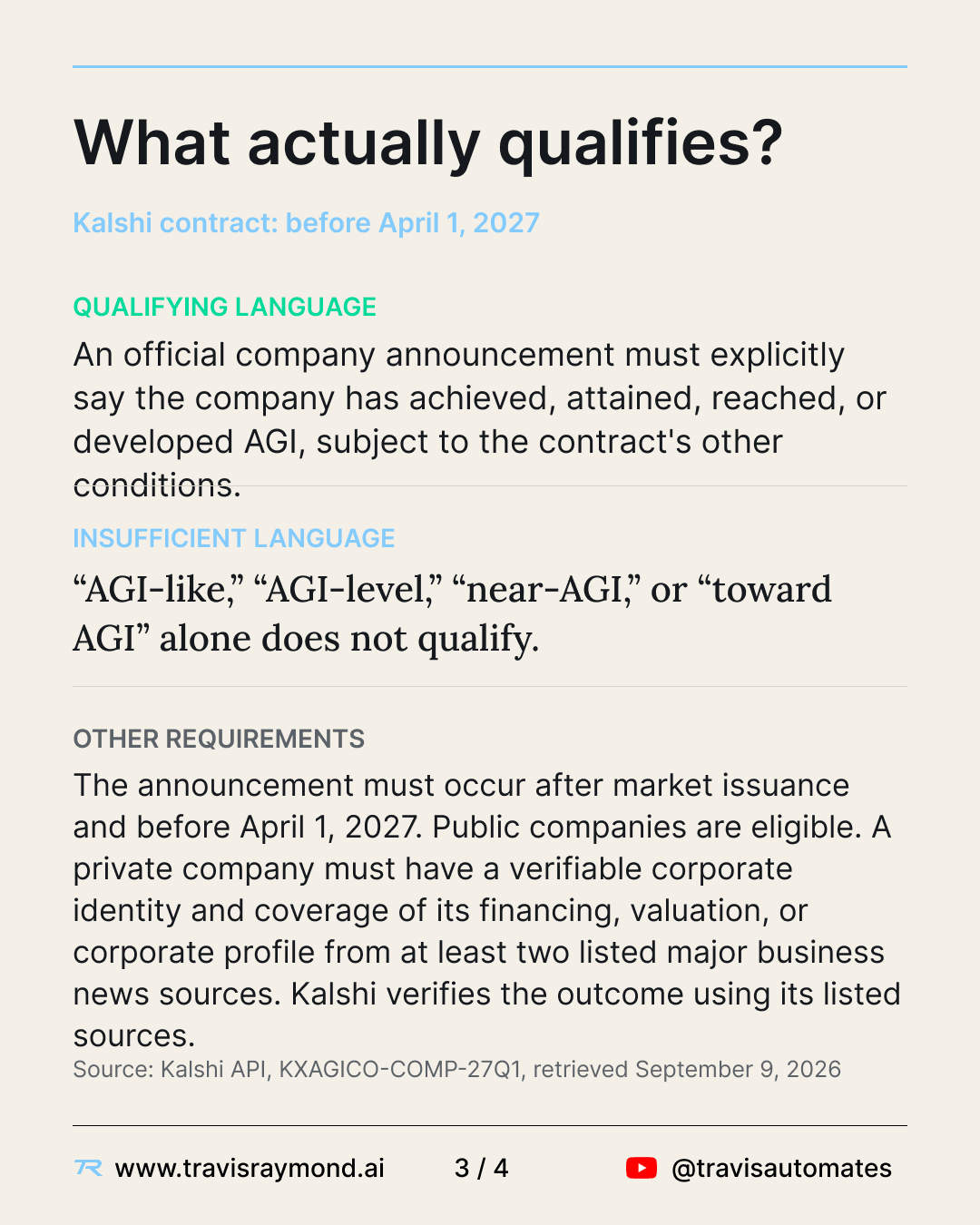
The contract language is where the market becomes much more precise.
According to the rules captured from the Kalshi contract, a qualifying announcement must explicitly state that the company has achieved, attained, reached, or developed AGI.
Related language alone does not qualify.
Terms such as "AGI-like," "AGI-level," "near-AGI," or "toward AGI" are insufficient unless the announcement also states that the company has actually achieved AGI.
There are additional requirements.
The announcement has to occur after the market was issued and before the relevant deadline.
Public companies qualify. Private companies can also qualify, but Kalshi requires their corporate identity to be verifiable and their financing, valuation, or corporate profile to have coverage from major business-news sources.
Kalshi also specifies the sources it can use to verify the outcome.
So the contract is not an open-ended philosophical question about intelligence.
It is a rule-defined event with a clear settlement process.
How to read prediction-market odds before sharing them
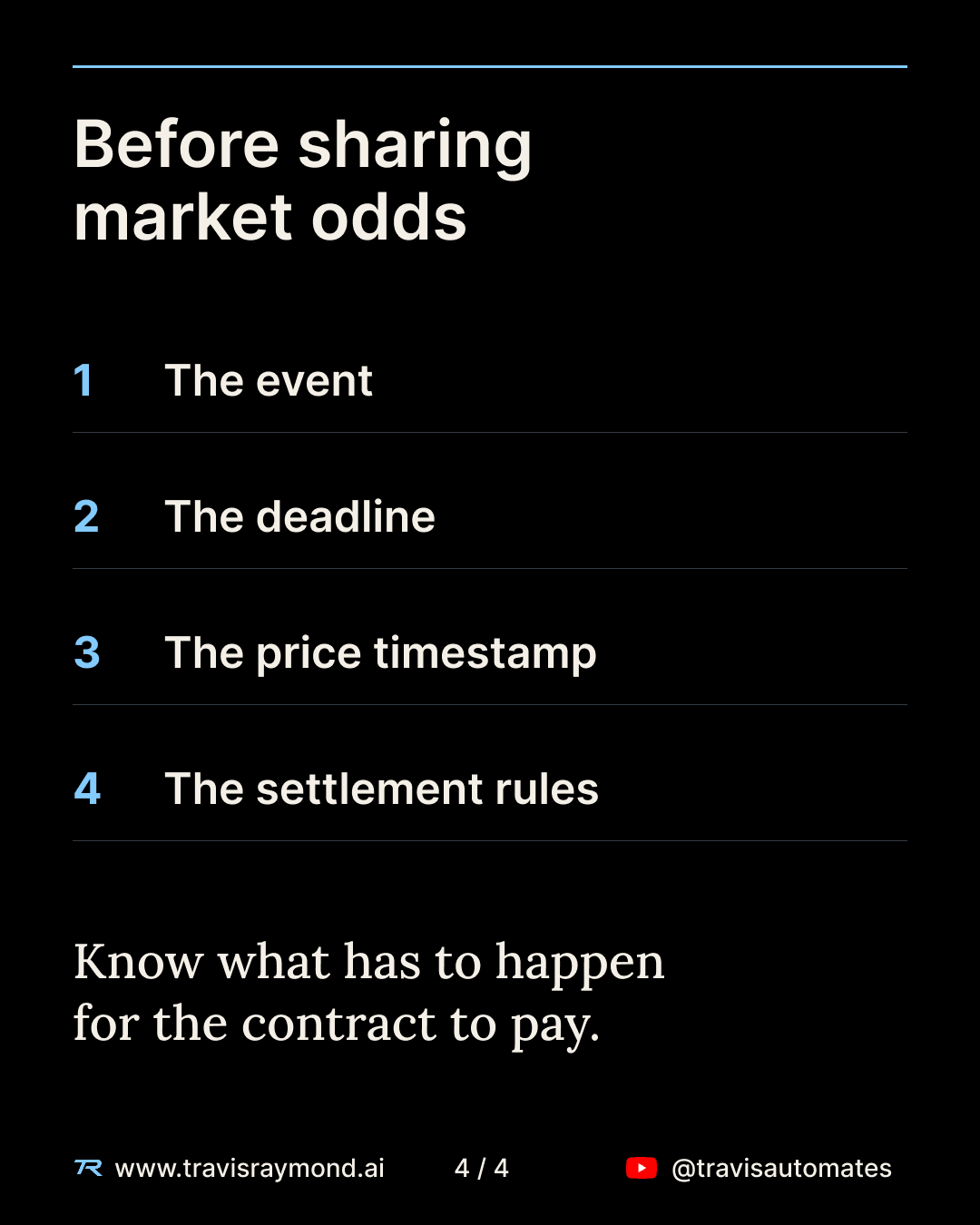
A prediction-market number should never be separated from four things:
The event.
What exactly has to happen?
The deadline.
By what date?
The price timestamp.
When was the market observed?
The settlement rules.
What evidence is required for the contract to resolve?
This matters because prediction-market prices often travel farther than the rules that produced them.
A screenshot that says "48% chance of AGI by April" is much more dramatic than the actual statement:
At this timestamp, traders priced a 48% chance that the specific Kalshi contract would resolve Yes under its written announcement criteria before April 1, 2027.
Those are not the same claim.
The first sounds like a forecast of technological capability.
The second is a forecast of a formal event under a contract.
Prediction markets can still be useful signals. But the rules define what the signal is about.
Where prediction markets fit
Prediction markets are strongest when the question is precise.
A well-written contract turns a vague public debate into something that can actually settle.
That can also make the market narrower than the headline people attach to it.
AGI is a good example because there is still no universally accepted scientific test that determines the exact moment it exists. A prediction market can avoid that ambiguity by defining a concrete trigger, such as a company making a formal announcement.
That makes the market easier to settle.
It also changes what the price means.
The Kalshi contract is useful as a measure of trader expectations around a formal AGI announcement under the rules. It should not automatically be treated as a direct probability that AGI, in the broad scientific sense, exists by the same date.
Reading the contract first is what keeps those two ideas separate.
Related Library Content
Sources & References
- [1]
- [2]Market Rules(Kalshi)
- [3]Market Outcomes(Kalshi)
- [4]Rules Summary(Kalshi)
- [5]Jensen Huang says AGI has arrived(Benzinga)
- [6]Kalshi AGI Market Contract Terms(Coinbase)