
AfterQuery: Why Expert Work Is Becoming AI Training Data
AfterQuery turns expert workflows into training and evaluation data for AI models. Its reported rise from a $300 million valuation to $3.2 billion shows how valuable human judgment has become in the race to improve reasoning models.
AfterQuery is an AI training-data company built around a straightforward premise: many of the capabilities AI labs want next depend on knowledge that is difficult to recover from public text alone.
The company works with specialists across fields such as software engineering, finance, law, medicine, and other professional domains. Instead of collecting only finished answers, AfterQuery builds datasets and training environments around the work itself: demonstrations, decisions, tool use, evaluations, preference signals, and reinforcement-learning tasks. Its current product catalog includes supervised fine-tuning data, RLHF, tool-calling environments, computer-use trajectories, custom evaluations, and other forms of expert-generated data.
Investors have assigned an extraordinary value to that business. AfterQuery announced a $30 million Series A at a $300 million valuation in April 2026. Five months later, Forbes reported that a new financing would value the company at $3.2 billion. Y Combinator partner Gustaf Alströmer told Forbes that the pace would make AfterQuery the fastest company in YC history to reach unicorn status.
The valuation is interesting because of what sits underneath it: a growing market for examples of how experienced people actually perform difficult work.
A reported tenfold valuation jump
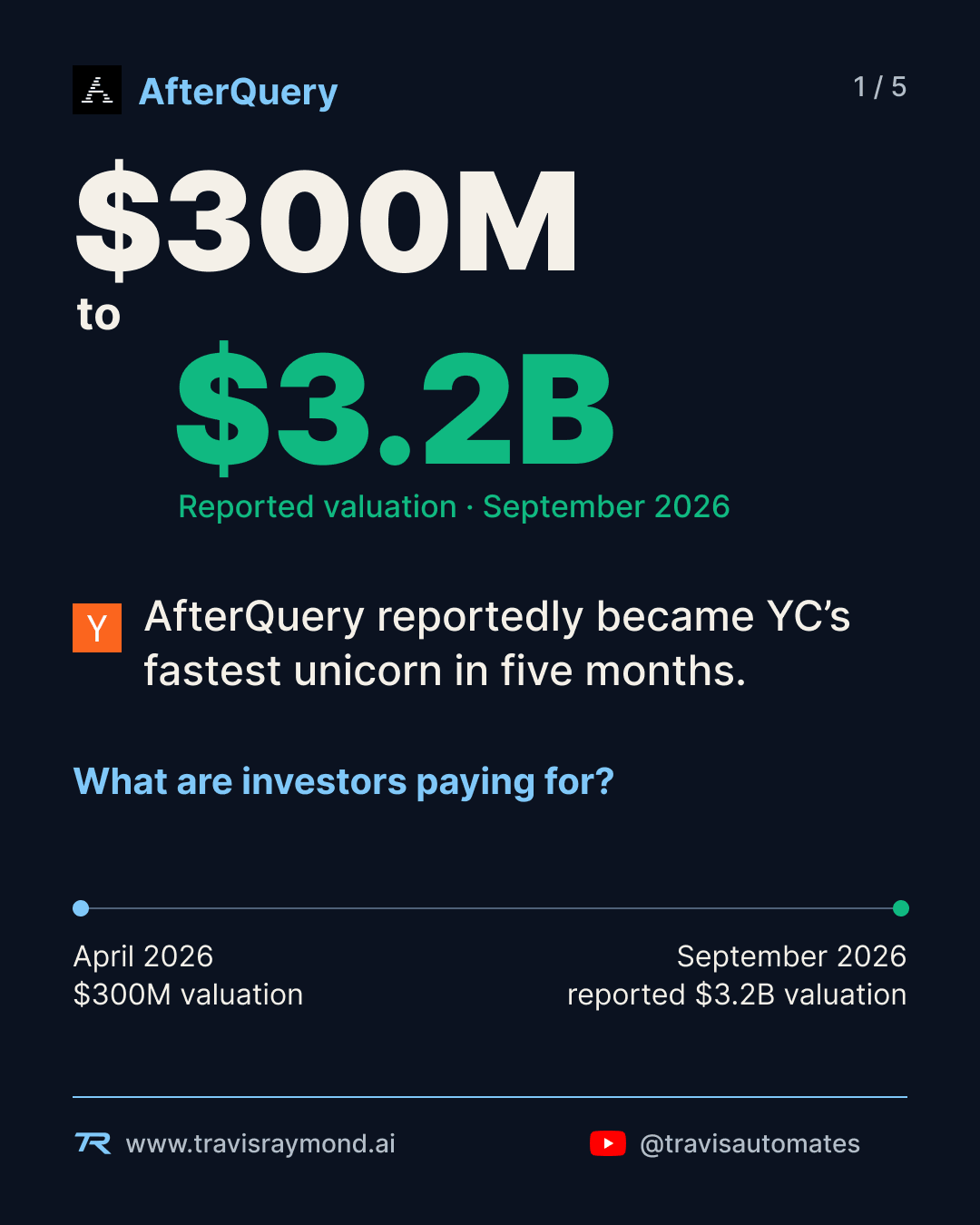
AfterQuery announced its $300 million valuation in April 2026 alongside a $30 million Series A led by Altos Ventures. The company said at the time that it had already surpassed a $100 million annualized revenue run rate.
By September, Forbes reported that investors were valuing AfterQuery at $3.2 billion. That is more than ten times the April figure in roughly five months. The company did not confirm the reported valuation when Forbes published the story, and the financing amount was not disclosed. TechCrunch subsequently reported the same $3.2 billion figure while noting that AfterQuery could not immediately be reached for comment.
The speed of that repricing is the interesting part. Investors are assigning multibillion-dollar values to companies whose product is largely the data, environments, and evaluation work required to make models better at difficult tasks.
Turning expert work into model data
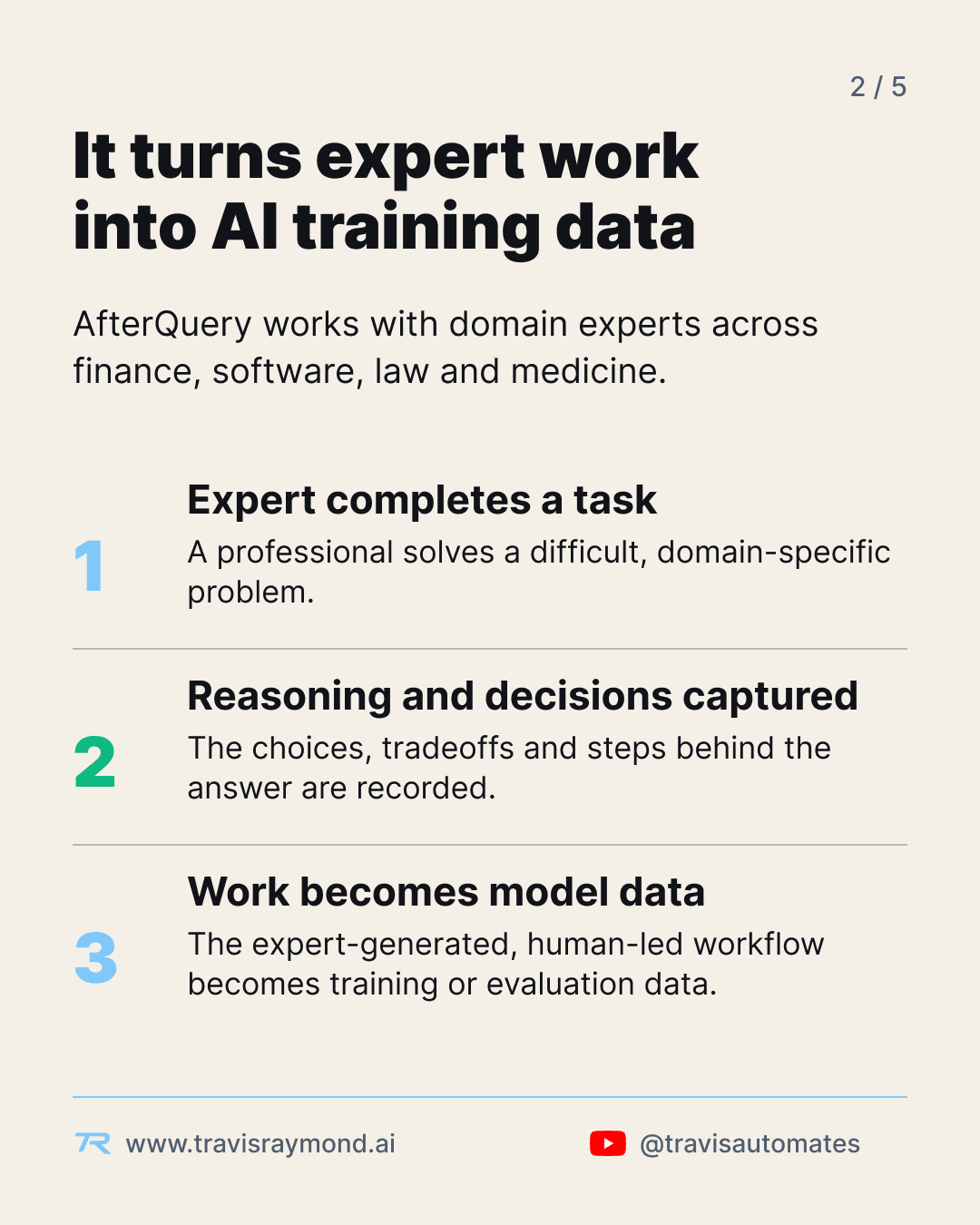
AfterQuery's process starts with people who already know how to perform a task.
That might be a software engineer debugging a repository, a financial analyst building a model, a lawyer working through a legal problem, or another specialist completing a domain-specific workflow.
The useful artifact is broader than the final answer. AfterQuery's own product material describes capturing expert demonstrations, reasoning traces, preference signals, debugging traces, tool interactions, rubrics, and full workflows. Its enterprise offering says datasets can be captured from experts step by step, decision by decision and then shaped for supervised fine-tuning, preference training, or reinforcement learning.
That creates several possible outputs. A demonstration can become supervised training data. Two competing answers can become a preference example. A repeatable task with a verifiable result can become a reinforcement-learning environment. A difficult workflow can also become an evaluation used to measure whether a model is improving.
The common input is expert behavior.
The information public text often leaves out
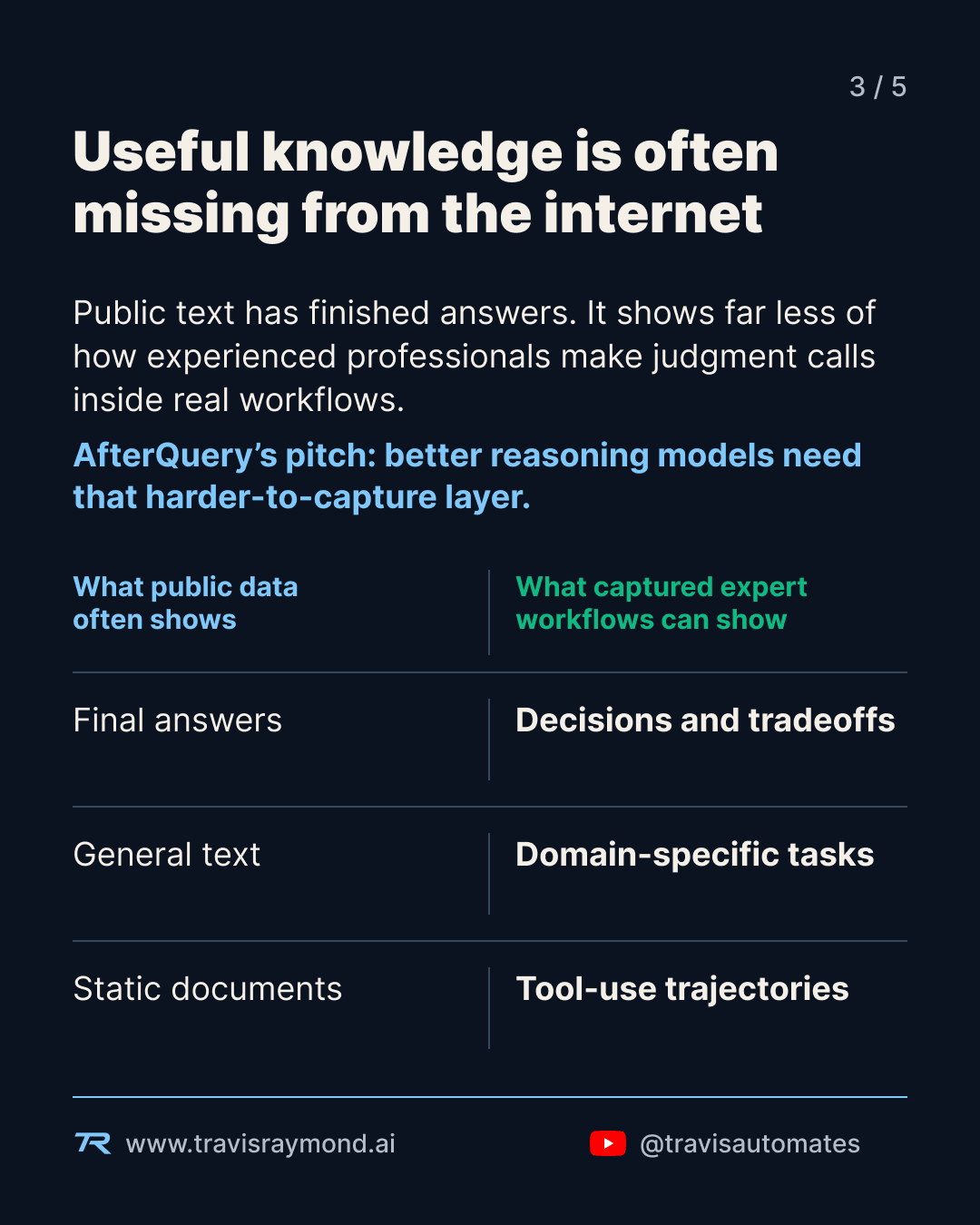
Most public documents are written to communicate a result.
A legal memo gives you the argument. A research paper gives you the findings. A spreadsheet may show the finished model. Documentation explains how software is supposed to behave.
Those artifacts contain useful information, but they often omit much of the judgment that produced them.
Which source did the analyst trust? Why was one assumption rejected? What did the engineer try before the successful fix? When did a lawyer decide one precedent was more relevant than another? Which tool did the person use next, and what happened when it failed?
AfterQuery's thesis is that these decisions are valuable training material. The company describes its professional datasets as a way to capture tacit knowledge and real-world judgment that conventional text and synthetic data may not reproduce well.
That is also why tool-use trajectories are becoming important. A model expected to operate software needs examples of action, feedback, correction, and completion. A static answer contains far less information about that process.
Revenue, customers, and evidence the data gets used
The valuation story would be less interesting without evidence that labs are buying and using the product.
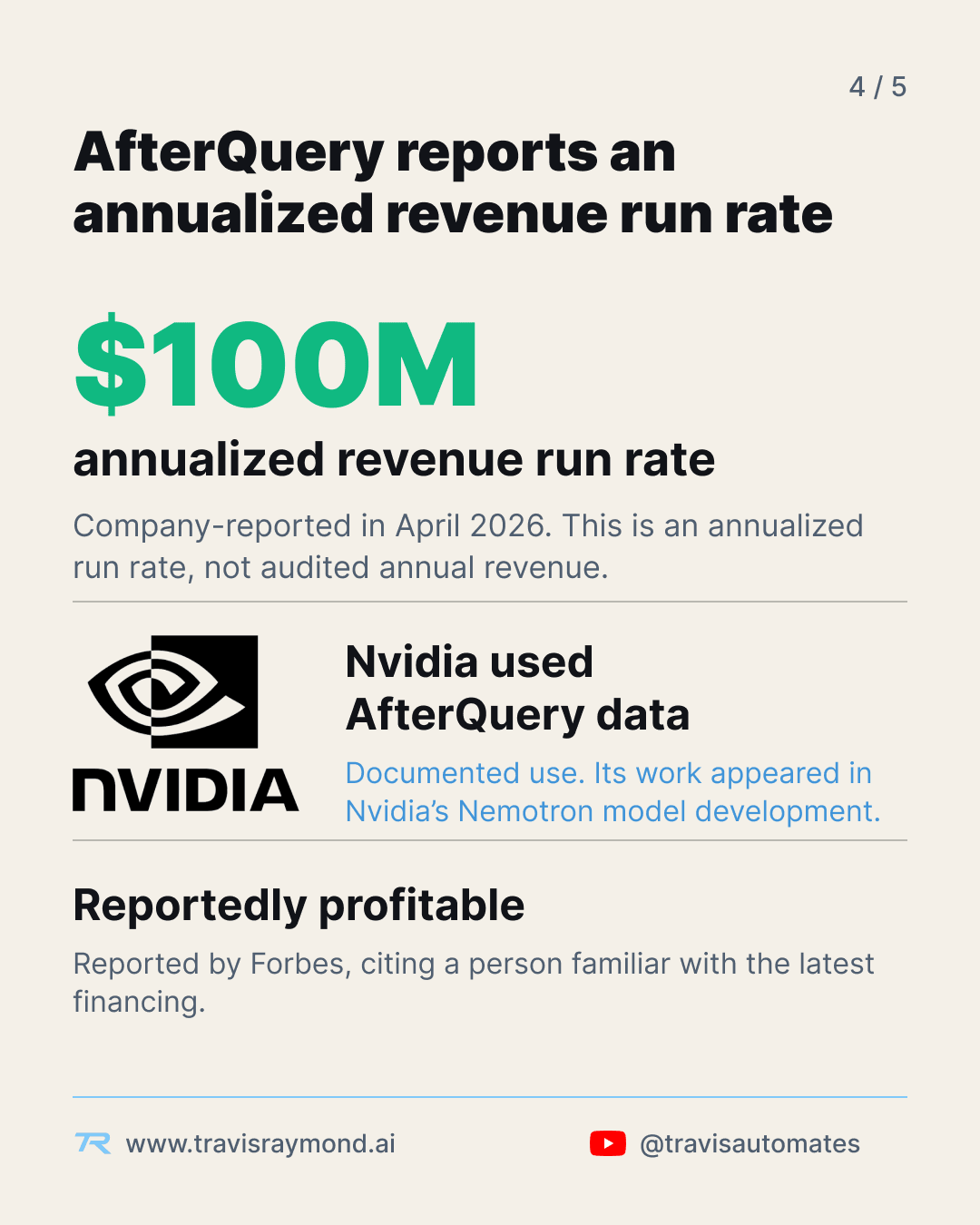
AfterQuery said in April that it had surpassed a $100 million annualized revenue run rate. Forbes later reported that founder Spencer Mateega said recurring revenue had reached the hundreds of millions by July. Forbes also reported that the company was profitable, citing a person familiar with the financing. Those figures should be treated as company-reported or source-reported metrics rather than audited financial statements.
There is also public evidence of AfterQuery data appearing in model development.
NVIDIA used AfterQuery tasks while improving Nemotron 3 Ultra on GDPval, a benchmark focused on economically valuable professional work. AfterQuery says it was the only outside data vendor named in NVIDIA's technical report and that its office-agent dataset supplied tasks involving file-grounded reasoning, professional deliverables, multi-step analysis, and judged outputs.
AfterQuery also publishes work around legal reasoning, software agents, financial analysis, computer use, and other professional evaluations.
That provides a clearer picture of the business than the valuation alone: expert data is being sold into model training and evaluation workflows where performance can be measured.
What investors may be pricing
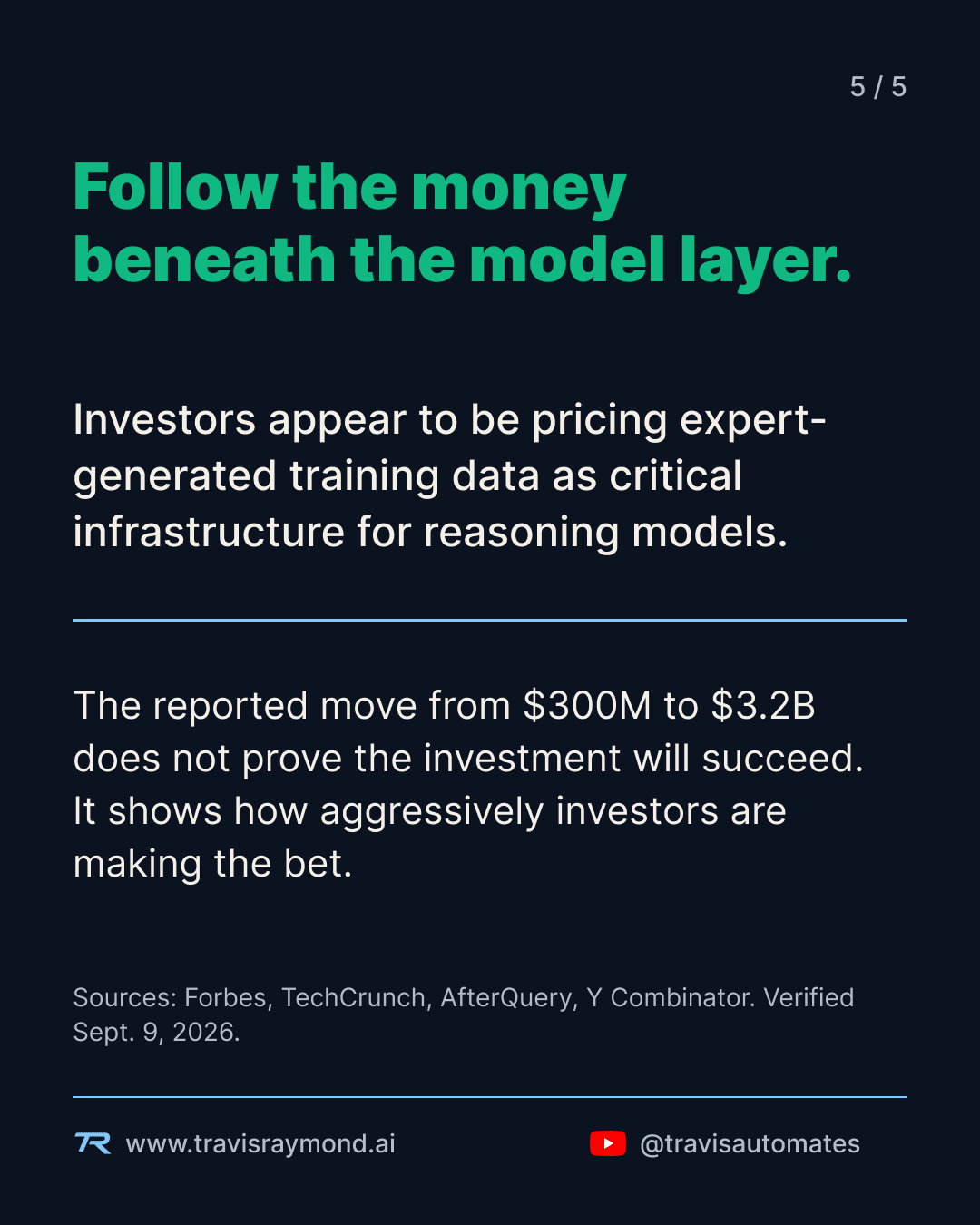
A reported jump from $300 million to $3.2 billion does not prove that AfterQuery will justify the valuation.
It does show how aggressively capital is being allocated toward the training layer around frontier models.
The first wave of large language models benefited from enormous quantities of text, code, images, and other material available online. As models move toward coding agents, computer use, professional analysis, and longer multi-step tasks, the desired training examples become more specialized.
AfterQuery is betting that the scarce input is increasingly high-quality examples of competent work: how an expert reaches a decision, uses tools, detects mistakes, responds to feedback, and finishes a task.
Its product lineup reflects that shift. The company sells tool-calling RL environments, computer-use environments, expert demonstrations, preference data, code-generation traces, custom evaluations, and professional-domain datasets.
The $3.2 billion figure should be read as a reported private-market mark, not a verdict on the company's eventual value. But the direction of the bet is clear. Investors are placing significant value on the companies supplying the human examples used to teach models how difficult work gets done.
Where AfterQuery fits
AfterQuery sits in a part of the AI stack that becomes easier to see once models move from answering questions to performing work.
A model can know a great deal and still struggle with a complicated spreadsheet, an unfamiliar repository, a legal workflow, or a sequence of tool calls. Those tasks require judgment across multiple steps, and they produce feedback along the way.
Training data for that kind of behavior looks different from another collection of web pages.
It can look like an expert demonstration. A full interaction trace. A rubric. A deliberately difficult task. A browser environment. A failed attempt followed by a correction. A comparison between two possible answers.
AfterQuery's reported valuation suggests that investors believe this layer will remain valuable as labs compete to make models more capable at professional work. Whether AfterQuery ultimately captures enough of that market to justify a multibillion-dollar valuation is still an open question.
The demand for better examples of human work is much easier to see.
Related Library Content
Sources & References
- [1]Human expertise, reimagined(AfterQuery)
- [2]Products(AfterQuery)
- [3]Solutions(AfterQuery)
- [4]Research(AfterQuery)
- [5]How AfterQuery Helped NVIDIA Hill-Climb GDPval(AfterQuery)
- [6]
- [7]