
Why a16z Just Raised $2.85B Across AI Infrastructure and Growth
Andreessen Horowitz announced $2.85 billion across two funds in four days: $1.1 billion for the Machine Age Fund and $1.75 billion added to Growth V. The split shows how capital is moving toward both AI infrastructure and later-stage company scale.
Andreessen Horowitz announced two large capital raises at the end of August 2026.
On August 28, a16z launched the $1.1 billion Machine Age Fund, a new vehicle focused on the physical infrastructure used by AI systems. Three days later, the firm announced another $1.75 billion for its fifth Growth fund, bringing Growth V from its original $6.75 billion size to $8.5 billion. Combined, the two announcements added $2.85 billion of capital across four days.
These are separate funds with different jobs.
The Machine Age Fund targets the hardware and infrastructure below the model layer. Growth V backs later-stage technology companies as they add products, expand into new markets, and scale toward much larger businesses.
Read together, the announcements show two places where a16z expects large amounts of capital to be needed: the physical stack that makes AI workloads possible, and the companies trying to turn new technology into durable businesses.
Two funds, two different jobs
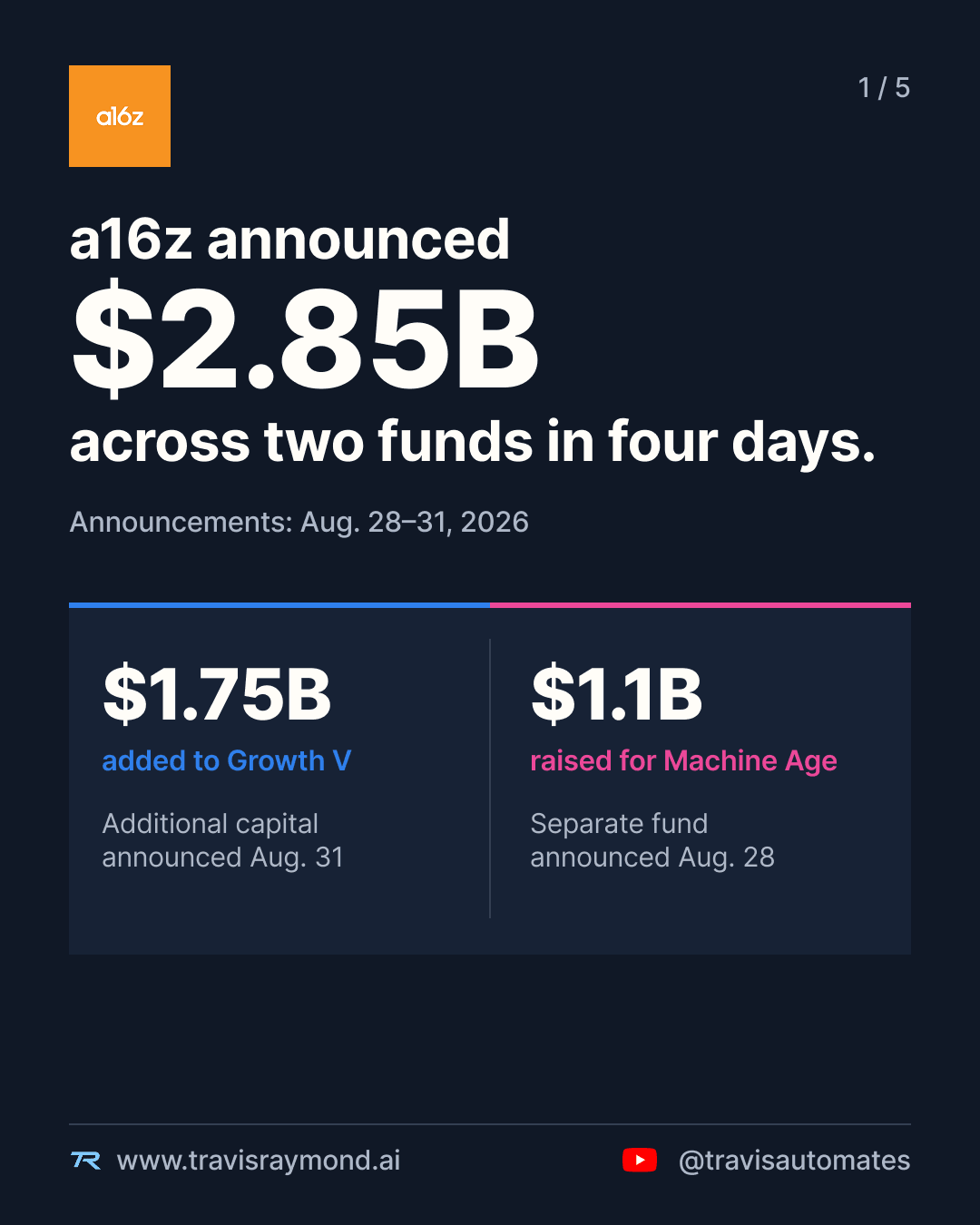
The headline number is $2.85 billion, but it is important not to treat that as one new AI infrastructure fund.
The first announcement came on August 28. a16z said it had raised $1.1 billion for the Machine Age Fund, a new fund built specifically around the physical infrastructure required to run and deploy AI.
On August 31, the firm announced an additional $1.75 billion for Growth V. That money was added to an existing fund rather than creating another new vehicle. Growth V had launched in January at $6.75 billion and now totals $8.5 billion.
So the four-day sequence was:
$1.1B new Machine Age Fund
plus
$1.75B additional Growth V capital
That is how the $2.85 billion figure should be read.
The $8.5B number needs context
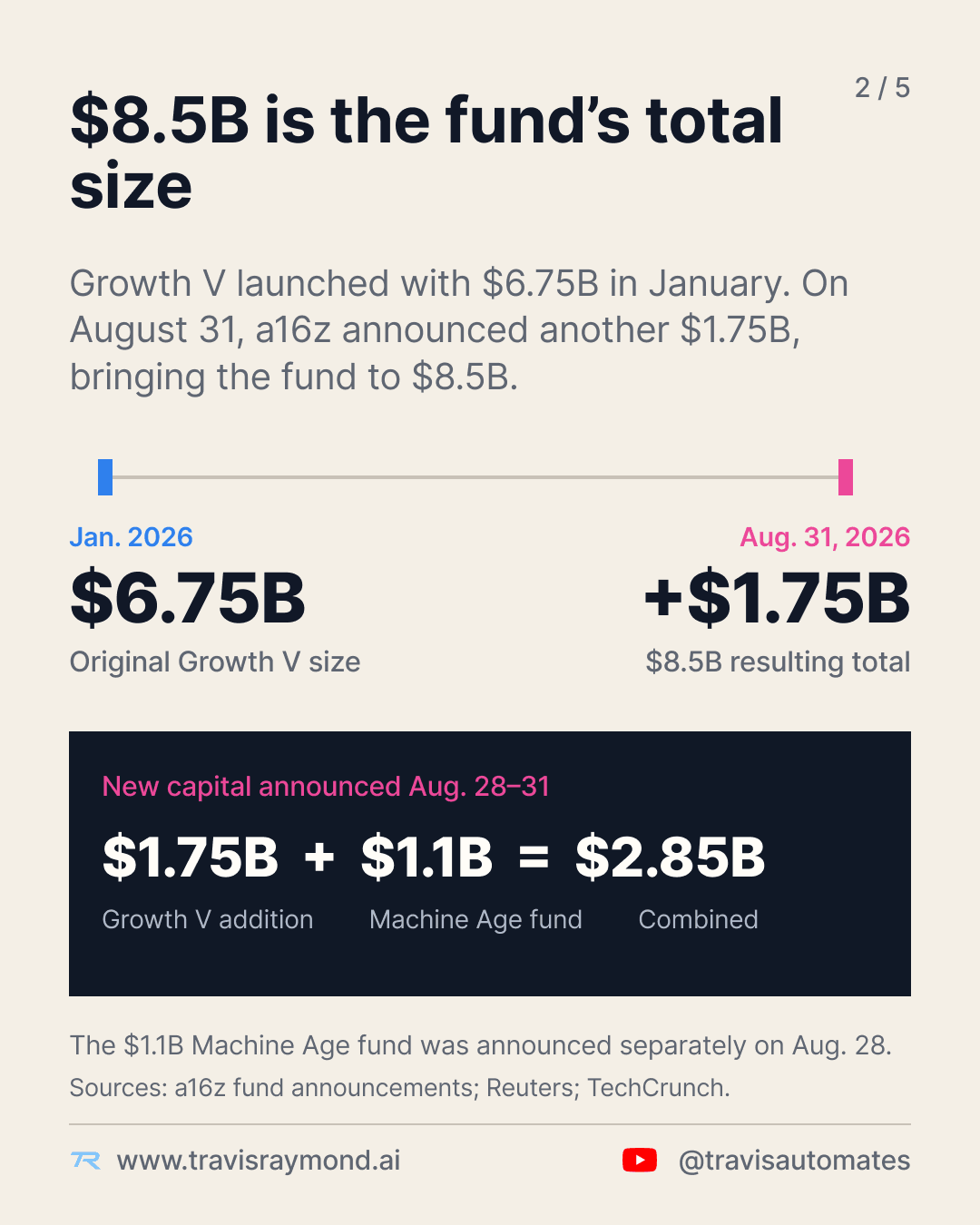
Growth V did not suddenly raise $8.5 billion in August.
a16z originally announced a $6.75 billion Growth fund in January 2026 as part of a broader $15 billion fundraising package. On August 31, the firm closed another $1.75 billion, bringing the same fifth Growth fund to $8.5 billion.
That distinction matters because the $8.5 billion figure represents the total size of the vehicle, not new capital announced during that week.
The additional $1.75 billion gives a16z more capacity to invest in growth-stage companies. The firm describes that stage as the period when companies move beyond initial product-market fit and begin adding products, entering new markets, building larger organizations, and preparing for much greater scale.
The separate Machine Age Fund adds another $1.1 billion next to that expansion.
The Machine Age bet sits below the model layer
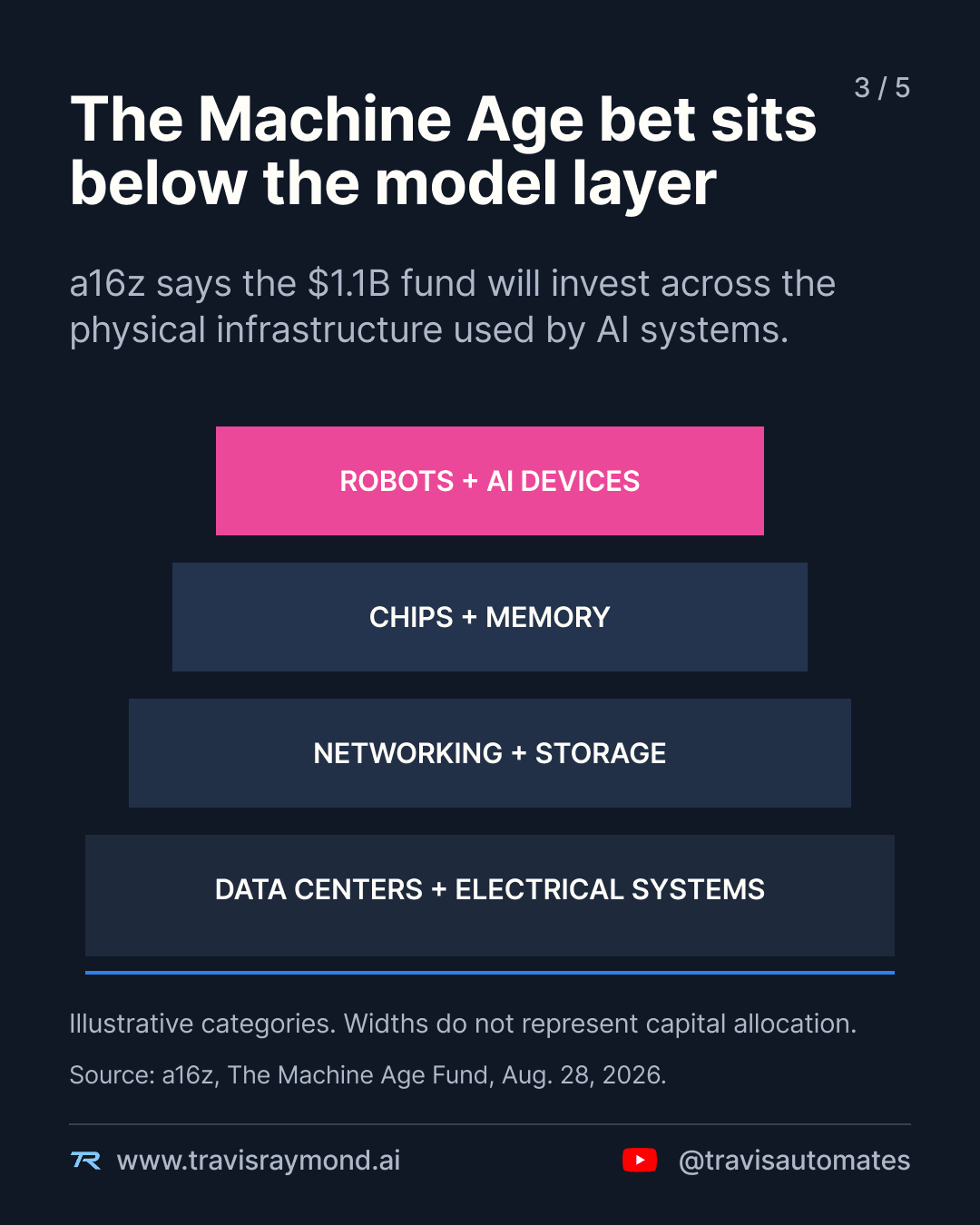
The Machine Age Fund is much more specific about where the money is supposed to go.
a16z says the fund will invest across the computer infrastructure on which AI runs, including chips, memory, networking, storage, data centers, robotics, and AI devices. The firm also calls out the supporting requirements around cooling, electrical infrastructure, materials, and real estate.
That makes this a different type of AI investment from backing another application company or model developer.
The thesis is that more capable AI creates more demand for computation. More computation requires faster chips, higher-bandwidth memory, better networking, larger data centers, more power, and eventually more machines operating outside the data center.
The fund is a bet on the physical bottlenecks behind that growth.
Growth capital is a different kind of bet
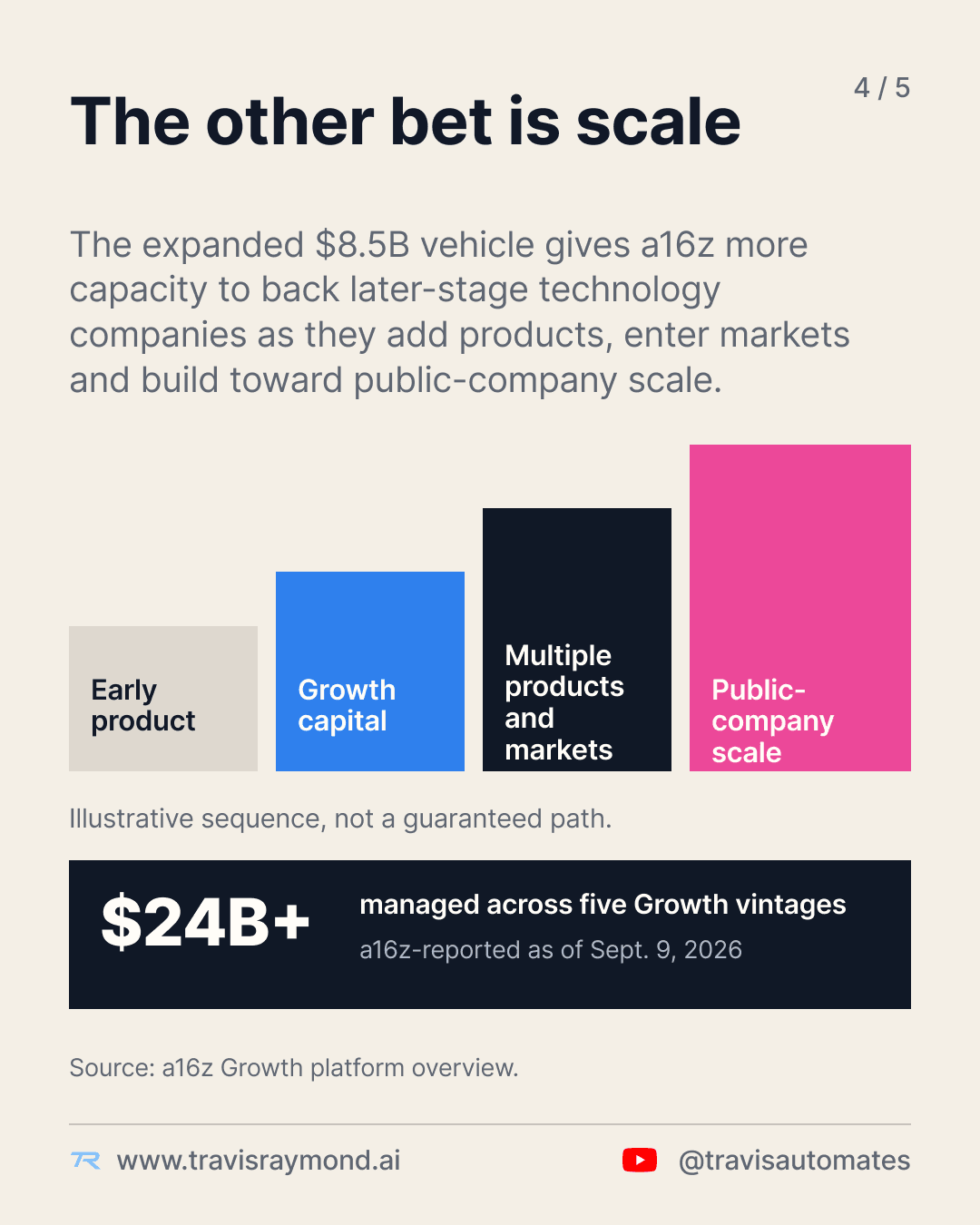
Growth V is broader.
a16z Growth invests in established technology companies that have already moved beyond the earliest stages. The platform currently says it manages more than $24 billion across five Growth vintages.
The goal of a growth fund is not to build a data center or manufacture a chip.
It gives later-stage companies more capital to expand products, enter new markets, hire, make acquisitions, build distribution, and support subsequent financing rounds.
a16z says its Growth team has worked with more than 100 companies over the past seven years. The firm is positioning the expanded fund around several large technology shifts, including enterprise and consumer AI, robotics, defense and industrial technology, healthcare, and the rebuilding of the compute stack.
That means Growth V should not be described as an $8.5 billion AI fund. AI is a major part of the thesis, but the vehicle is broader than AI infrastructure alone.
The capital is moving in two directions
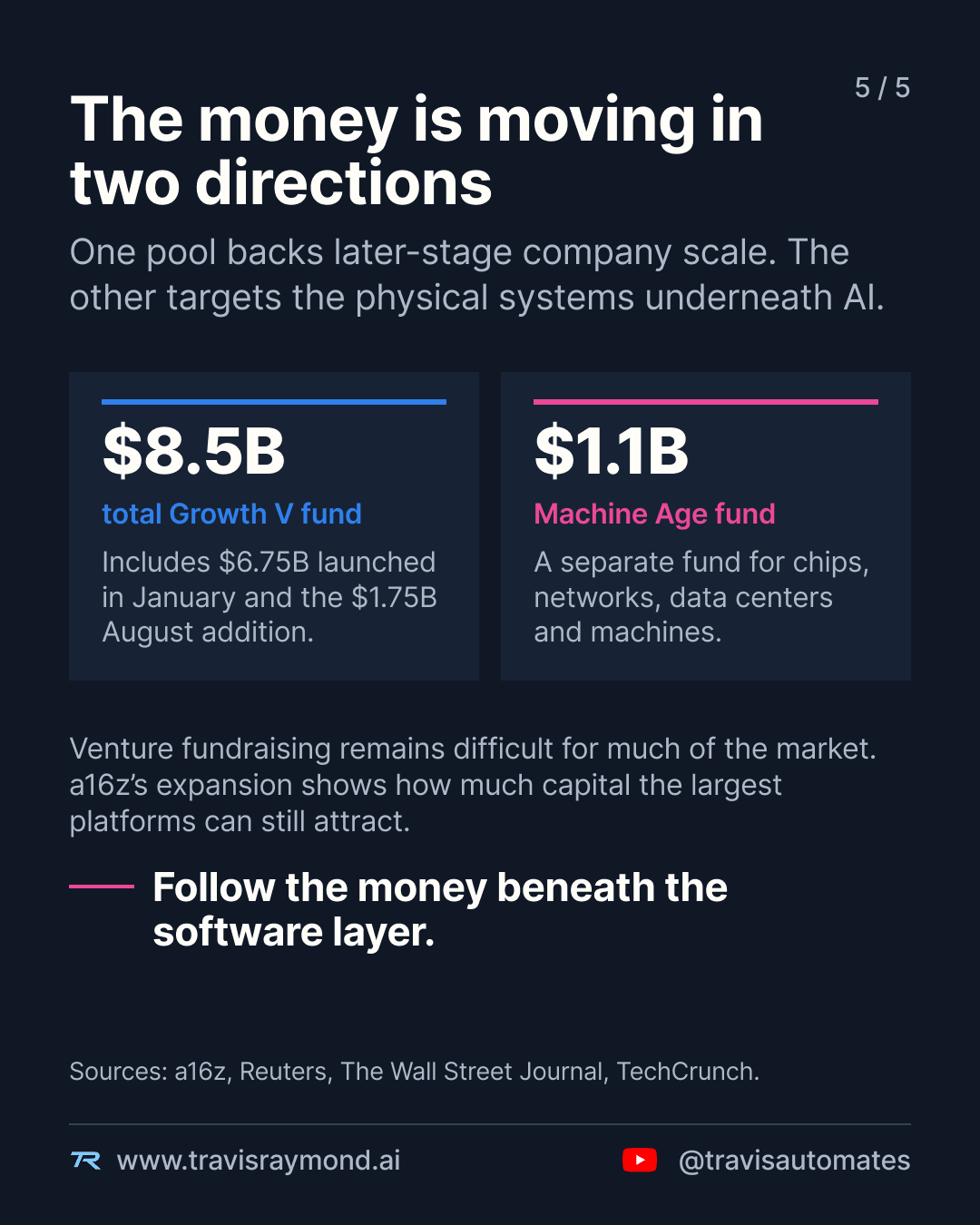
The two announcements point at different parts of the same technology cycle.
The $1.1 billion Machine Age Fund is aimed at the physical inputs underneath AI: compute, memory, networking, storage, data centers, electrical infrastructure, robotics, and devices.
The $8.5 billion Growth V fund gives a16z a much larger pool for backing companies that have already reached meaningful scale and need more capital to keep expanding.
Those are different investment strategies.
One is built around the infrastructure required to run increasingly demanding workloads.
The other is built around companies trying to turn technological shifts into large businesses.
The four-day fundraising sequence is useful because it shows both sides at once.
Where a16z is placing the bet
The $2.85 billion announced between August 28 and August 31 should not be treated as one giant infrastructure allocation.
It is two capital pools.
The Machine Age Fund is a direct bet on the physical buildout beneath AI.
Growth V is a broader bet on later-stage technology companies and the amount of capital required to scale them.
Together, they show how a16z is positioning itself around both the supply side and the company-building side of the current technology cycle.
That distinction is more useful than the headline number alone.
Related Library Content
Sources & References
- [1]The Machine Age Fund(Andreessen Horowitz)
- [2]Expanding the a16z Growth Fund and Platform(Andreessen Horowitz)
- [3]Why Are We Here? Why Did We Raise $15B?(Andreessen Horowitz)
- [4]a16z Growth(Andreessen Horowitz)
- [5]
- [6]
- [7]Andreessen Horowitz Launches Machine Age Fund to Tackle AI Supply Bottlenecks(The Wall Street Journal)